logo
Mengirim pesan
Shenzhen Ofeixin Technology Co., Ltd
Tentang kami
Mitra Profesional & Andal Anda.
QOGRISYSberkomitmen secara profesional untuk menyediakan solusi koneksi IoT yang lengkap kepada pelanggan.Perusahaan berfokus pada industri komunikasi.Setelah bertahun-tahun pengalaman pasar industri dan layanan pelanggan, perusahaan memiliki keberanian untuk menghadapi tantangan teknis ekstrem dan membantu pelanggan memecahkan kesulitan.Perusahaan memiliki sumber daya pendukung berkualitas tinggi mulai dari koneksi nirkabel jarak pendek pita lebar, komunikasi seluler jaringan area luas hingga ...
Pelajari Lebih Lanjut

0

Tahun Didirikan

0

Juta+
Karyawan

0

Juta+
Pelanggan yang Dilayani

0

Juta+
Penjualan Tahunan
CINA Shenzhen Ofeixin Technology Co., Ltd Kualitas tinggi
Segel kepercayaan, pemeriksaan kredit, RoSH dan penilaian kemampuan pemasok. Perusahaan memiliki sistem kontrol kualitas yang ketat dan laboratorium pengujian profesional.
CINA Shenzhen Ofeixin Technology Co., Ltd Pengembangan
Tim desain profesional internal dan bengkel mesin canggih. Kami bisa bekerja sama untuk mengembangkan produk yang Anda butuhkan.
CINA Shenzhen Ofeixin Technology Co., Ltd Produksi
Mesin otomatis canggih, sistem kontrol proses yang ketat. Kami dapat memproduksi semua terminal listrik di luar permintaan Anda.
CINA Shenzhen Ofeixin Technology Co., Ltd 100% pelayanan
Kemasan besar dan kecil yang disesuaikan, FOB, CIF, DDU dan DDP. Biarkan kami membantu Anda menemukan solusi terbaik untuk semua masalah Anda.

Kualitas Modul WiFi7 & WiFi HaLow Modul Pabrikan

Temukan Produk Yang Lebih Baik Memenuhi Kebutuhan Anda.
Kasus & Berita
Hot Spot Terbaru.
Katakan selamat tinggal pada Lag! Modul O9201SB teknologi tinggi ini merevolusi hiburan rumah dengan peningkatan skala penuh!
Sudah larut malam, dan Anda berada dalam acara favorit Anda ketika tiba-tiba, layar membeku menjadi acara slide. Seluruh keluarga berjuang untuk bandwidth, dan latensi game Anda meroket.Apakah masalah jaringan yang membuat frustrasi ini mengganggu pengalaman rumah pintar AndaJangan khawatir!Qogrisys telah mengembangkan modul mutakhir yang dilengkapi dengan **Wi-Fi 6 + BT5.4**️O9201SByang diam-diam merevolusi industri set-top box dengan "upgrade pengalaman" yang tak tertandingi! 1. Titik Sakit dari Hiburan Rumah: Apakah Set-Top Box Anda Benar-benar "Cerdas"? Dengan meningkatnya video 4K / 8K definisi tinggi, game cloud, dan perangkat rumah pintar, jaringan rumah berada di bawah tekanan besar: "Satu Jaringan, Beberapa Perangkat" Memimpin Ke Lag**: Ketika TV, telepon, tablet, dan speaker pintar semuanya online, Wi-Fi 4/5 tidak bisa mengikuti!   Video High-Definition Berubah menjadi "Mosaik"**: Video 8K membutuhkan bandwidth lebih dari 100Mbps per detik, dan modul tradisional berjuang untuk memberikan.   Biaya Chips Inti yang Tinggi**: Penyesuaian sangat rumit dan mahal, membuat produsen frustrasi.   2. MemperkenalkanO9201SB: Wi-Fi 6 + BT5.4 Mendefinisikan "Smooth" 1. Kecepatan Peningkatan: Instan 8K Video Streaming Teknologi Simultaneous Dual-Band**: 2,4 GHz untuk penetrasi dinding yang stabil, 5 GHz untuk kecepatan yang sangat cepat, dengan laju 2T2R hingga 1200Mbps. Video 8K dimuat secara instan,dengan buffering nol saat menyeret bilah kemajuan! MU-MIMO + OFDMA**: Beberapa perangkat dapat terhubung secara bersamaan tanpa bersaing untuk bandwidth. 2Bluetooth 5.4: Membuka Peluang Pintar Baru Bluetooth Remote Control with Instant Response**: Nikmati kontrol suara yang lebih sensitif dan operasi yang mulus. Hubungkan Speaker Eksternal dan Game Controller dengan Zero Latency**: Merendam diri ke dalam pengalaman game dan hiburan yang sepenuhnya mendalam.   3Teknologi Terdepan + Pelayanan Tingkat Tinggi: Win-Win untuk Produsen dan Pengguna 1. Mandiri dan Aman, Memastikan Keamanan Lengkap Chip memenuhi standar teknis internasional, memastikan stabilitas dan keamanan. Enkripsi data + server lokal memberikan perlindungan privasi yang komprehensif. 2. Fleksibel kustomisasi, respon cepat Tim R&D profesional mendukung "adaptasi mendalam", menyelesaikan kustomisasi dari desain hingga produksi massal hanya dalam 30 hari. Rantai pasokan yang dioptimalkan mengurangi biaya sebesar 20% dan memperpendek siklus pengiriman sebesar 50%.   4Masa Depan Sudah Di Sini: Mengambil "Golden Gateway" ke Smart Home Untuk pengguna,O9201SBmenawarkan peningkatan pengalaman yang mulus dan mulus.Ini adalah alat yang ampuh untuk mengurangi biaya dan meningkatkan efisiensi.Set-top box yang dilengkapi dengan modul ini tidak hanya bisa menjadi pusat hiburan rumah tetapi juga terintegrasi dengan lancar dengan peralatan rumah pintarIni menempatkan mereka untuk menangkap gerbang inti ke pasar rumah pintar triliun dolar!     Dari "berguna" menjadi "sangat baik", dan dari ketergantungan teknologi menjadi kepemimpinan teknologi,O9201SBmodul yang dikembangkan olehQogrisys adalah menulis ulang aturan industri set-top box dengan kinerja yang luar biasa dan layanan tingkat tinggi.O9201SBtidakTidak hanya memilih modul, Anda memilih "revolusi pengalaman" yang berorientasi pada masa depan.  
O9201UB Keadaan Saat Ini Industri Proyektor: Wireless Connectivity Pain Points Need Urgent Breakthrough
Karena proyektor pintar menjadi semakin umum saat ini, permintaan pengguna untuk kualitas gambar dan fungsi terus meningkat.Stabilitas dan kecepatan konektivitas nirkabel telah menjadi kemacetan yang menghambat peningkatan pengalaman pengguna: · Transmisi Konten 4K / 8K gagap: Video resolusi tinggi membutuhkan bandwidth yang sangat tinggi, dan modul Wi-Fi tradisional sering menderita keterlambatan dan buffering di lingkungan yang kompleks. · Interferensi yang parah di antara beberapa perangkat: Ketika proyektor terhubung secara bersamaan dengan beberapa perangkat seperti smartphone, tablet, dan speaker, kemacetan jaringan sering menyebabkan gangguan sinyal. · Pengalaman Bluetooth Periferal yang buruk: Protokol yang lebih tua menderita latensi tinggi dan kemampuan anti-interferensi yang lemah, yang mengakibatkan koneksi yang tidak stabil untuk speaker nirkabel, pengontrol game, dan perangkat lainnya. · Konflik Antara Konsumsi Listrik dan Penyebaran Panas: Transmisi kecepatan tinggi datang dengan konsumsi daya yang tinggi, mempengaruhi umur baterai perangkat dan bahkan menyebabkan masalah disipasi panas.       Titik nyeri ini merusak kredibilitas merek Anda Aku.O9201UBModul: "Jantung Tanpa Kabel" yang Dirancang untuk Proyektor QOGRISYStelah sangat terlibat dalam komunikasi nirkabel selama 12 tahun.Wi-Fi 6 + Bluetooth 5.4 modul dual-modeO9201UBdirancang dengan empat keuntungan inti untuk merestrukturisasi pengalaman nirkabel dalam skenario proyeksi: 1.Wi-Fi 6 Ultra-Speed Transmission, 4K/8K Lemes dan tak terganggu · Dual-Band Simultan, Smart Switching: 2.4GHz menawarkan kemampuan penetrasi dinding yang kuat, Kecepatan dapat mencapai 1200Mbps sementara 5GHz, mendukung modus 2T2R DBAC dan 1T1R DBDC,memungkinkan penggunaan frekuensi yang berbeda secara bersamaan untuk akses internet dan casting layar, mengucapkan selamat tinggal kepada gagap. · Teknologi MU-MIMO + OFDMA: Mendukung transmisi kecepatan tinggi antara beberapa perangkat secara bersamaan, memastikan proyeksi yang stabil dan lancar bahkan ketika beberapa pengguna berbagi jaringan. · Teknologi Beamforming: Memperiksa posisi perangkat secara akurat, meningkatkan kekuatan sinyal secara dinamis, dan menghilangkan zona mati proyeksi, memastikan cakupan sinyal penuh baik di ruang tamu atau konferensi   ② Bluetooth 5.4 + Low Latency, "Zero Perception" Synchronization Audio-Video · 2Mbps Bluetooth Berkecepatan Tinggi: speaker nirkabel/headphone ∙ latensi rendah28ms(rata-rata industri: 50ms), memberikan efek audio seperti konser dengan "sinkronisasi audio-video". · AFH Teknologi Anti-Interferensi: Menghindari saluran 2.4G yang padat secara otomatis, memungkinkan beberapa perangkat (remote control + mikrofon + speaker) untuk hidup berdampingan tanpa gangguan, memungkinkan "respon instan" untuk kontrol suara. · Teknologi HCI: Menyediakan cadangan menengah, kompatibel di seluruh versi kernel; antarmuka USB juga dapat terhubung ke speaker Bluetooth, menawarkan efek suara premium, menghemat waktu debugging,dan mengurangi penggunaan pin di antarmuka PCM   ③ Ukuran kompak + Konsumsi daya rendah, kebebasan desain yang lebih besar · Dimensi Kompak: Ukuran ultra kecil 15×13×2,3mm, cocok untuk desain proyektor ultra tipis, menghemat ruang internal. · Manajemen Daya Cerdas: Konsumsi daya kolaboratif Wi-Fi + Bluetooth berkurang 20%, memperpanjang waktu berjalan proyektor baterai bawaan 1,5 jam, memastikan tidak terganggu selama berkemah di luar ruangan   4.Adaptasi Fleksibel, Integrasi Mudah · Antarmuka USB 2.0: Kompatibel dengan model proyektor arus utama, mengurangi biaya pengembangan untuk produsen. · Sertifikasi Berbagai: Mendukung enkripsi WPA3, BLE Audio, dan standar lainnya, memastikan keamanan dan kompatibilitas data. Aku tidak tahu.II.Dapatkan "Proyeksi Tanpa Kabel" di Lautan Biru Baru Sekarang! Pasar proyektor cerdas global melebihi $ 80 miliar pada tahun 2025, dengan pengalaman nirkabel menjadi faktor pengambilan keputusan utama bagi pengguna.O9201UBtidak hanya "alat melihat" tetapi jugapusat hiburan rumah, pusat kolaborasi bisnis, dan gateway rumah pintar. Skenario Hiburan Rumah: Casting layar game nirkabel: Mendukung transmisi 4K @ 60fps latensi rendah, dipasangkan dengan speaker Bluetooth imersif.Integrasi rumah pintar: Koneksi Wi-Fi langsung untuk mengontrol layar / lampu, menciptakan sistem teater yang mendalam. Skenario Kantor Bisnis: Berbagi layar nirkabel multi-perangkat di antara beberapa perangkat: Mendukung demonstrasi dari beberapa terminal, meningkatkan efisiensi pertemuan sebesar 50%. Optimasi kolaborasi jarak jauh: Alokasi bandwidth cerdas QoS memastikan konferensi video stabil Skenario Pendidikan: Jaminan kelas online: Desain anti interferensi memastikan tampilan kursus 4K lancar. Dukungan pengajaran interaktif: latensi mikrofon Bluetooth < 30ms, memungkinkan interaksi guru-mahasiswa tanpa lag. III.MemilihO9201UBArtinya Anda Mendapatkan Lebih dari Sekedar Modul ▶Teknologi Lanjutan, Performance Benchmark:Berdasarkan protokol IEEE 802.11ax dan Bluetooth 5.4, kinerja melampaui modul tradisional sepenuhnya. ▶ Jaminan Layanan:Dukungan teknis 24x7, menyediakan layanan komprehensif "modul + driver + optimasi skenario". ▶ Kolaborasi Ekosistem, Skenario Peningkatan:Di luar proyektor, dapat diintegrasikan dengan perangkat rumah pintar (misalnya, lampu, layar), membantu proyektor ditingkatkan menjadi pusat kontrol cerdas. Kesimpulan: Masa Depan Proyeksi Tanpa Kabel Terdefinisi oleh Anda! PeraturanO9201UBmodul, dengan keunggulan inti "cepat, stabil, dan efisien", menyediakan solusi konektivitas nirkabel utama untuk industri proyektor.Apakah itu adalah pengalaman home theater yang terbaik atau kolaborasi bisnis yang efisien, itu bisa ditangani dengan mudah.QOGRISYS siap untuk berkolaborasi dengan Anda, mendorong transformasi industri melalui inovasi teknologi, dan membuat setiap proyektor gerbang ke "kebebasan nirkabel"!
PV Shutdown Acceptance Testing Tightens: What Really Matters When Choosing PLC Modules
I. The acceptance logic has changed: from "whether it's installed or not" to "only counts if it's tested". Rooftop photovoltaic projects in Shenzhen are undergoing a substantial upgrade in acceptance standards. Shenzhen's local engineering construction standard SJG 220-2026 has been implemented , which sets precise quantitative indicators for rapid shutdown: the shutdown action should be completed in no more than 30 seconds, the voltage within 1 meter of the photovoltaic array should drop to below 80V, and the voltage outside 1 meter should drop to below 30V. This isn't something that can be simply dismissed as "installing fast shutdown." On-site acceptance personnel will first locate all shutdown trigger points, confirming the consistency of logic at fire exits, near the inverter, and at the remote control terminal; then verify the correspondence between the shutdown devices and components; finally, record the time and voltage at the measurement points specified in the drawings, confirming that the array boundary, both inside and outside the project's adopted version, meets the requirements. Simply stating "RSD is written in the bill of materials" is no longer sufficient for acceptance; the system-level voltage control performance is the final criterion. The Shanghai group standard T/ESETA 000007—2026 further refined the requirements: shutdown must be completed within 30 seconds after triggering, and the external voltage of the reachable boundary must be ≤30V, the internal voltage must be ≤120V, and the output power must be ≤1W. It also clearly states that "shutdown is divided into component-level and string-level, and component-level solutions should be given priority in densely populated places." The North American market has more stringent entry barriers. NEC 690.12 requires that controlled conductors outside the array boundary must drop below 30V within 30 seconds, and that electric shock protection for firefighters within the boundary must be achieved through a listed PVHCS device or voltage limiting method. When selecting a PLC solution, the chip's modulation method and noise immunity directly determine the number of components the system can support. II. SunSpec's hierarchical logic: Chip compliance ≠ Module certification ≠ Complete system approval This is a critical issue that is most easily overlooked by switch manufacturers and module purchasers. The SunSpec Alliance's "Communication Signal for Rapid Shutdown" specification defines the communication protocol between the transmitter and receiver: the transmitter continuously sends a signal in an "operational" state, and the receiver triggers shutdown upon detecting a signal loss. The SunSpec Alliance explicitly states: "Only the 'SunSpec Certified' mark proves the complete and successful implementation of the SunSpec Rapid Shutdown communication signal functionality specification. Claims of 'SunSpec compliance' or 'SunSpec compatibility' by manufacturers or other third parties are not equivalent to a certificate issued by SunSpec." This means that chip support for protocols, module passing conformance testing, and complete device certification are three independent verification levels. Module-level protocol compatibility is only the first hurdle; safety certifications such as UL 1741 and CSA C22.2 at the whole-unit level are the passports to market entry. This understanding is crucial for circuit breaker manufacturers' selection decisions.   III. Three Engineering Dimensions for Module Selection: Size, Power Consumption, and Networking Capability For circuit breaker manufacturers, the "PLC support" and "integrated line driver" features on the chip specifications are just the starting point. What truly determines whether a solution can be mass-produced and implemented is the engineering adaptability at the module level. The first dimension is size. The circuit breaker is installed on the back panel of each photovoltaic module, where space is extremely limited, and it shares this limited area with junction boxes and cables. The module's package size directly determines the design space and installation method of the circuit breaker housing. PLC modules using the Hisilicon PS0211 chipset typically use a 28.12×18.00mm pin header package or a 20.0×14.2mm gold finger package, while some module manufacturers have launched a further miniaturized version of 20.0×11.0mm. The second dimension is power consumption. The shutdown device is powered by the photovoltaic panel itself and has no independent power input. The static power consumption of the HiSilicon PS0211 solution is ≤0.15W (in the grid-connected, non-packet-sending state), and the dynamic operating power is ≤0.5W. During periods of insufficient sunlight, when the modules are shaded, or at night, the module must rely on extremely low standby power consumption to maintain its monitoring capability, waiting for the "operation allowed" signal sent by the inverter transmitter. The third dimension is networking capability. PLC signals are transmitted via DC power lines, and the shutdown device, acting as a STA node, needs to establish a reliable communication link with the CCO at the inverter end. The HiSilicon PS0211 solution supports rapid networking in 10 seconds in a typical 200-node, 2-tier network scenario, supporting dynamic routing and multi-path addressing, and unicast, multicast, and broadcast command propagation methods. For the requirement of unified access for multiple components and devices in distributed photovoltaic systems, the networking scale and time performance of the modules directly affect the system commissioning efficiency. IV. Scene Alignment of Two PLC Modules from Qogrisysy In the selection of photovoltaic shutdown PLC modules, Qogrisysy provides two products based on different chip solutions, each corresponding to different engineering focuses. the S130N-ISI (Linktronics VC6330 solution) is its ultra-small size. This module uses LCC packaging, with a PCB size controlled at 12.6×20.6×2.5mm. It operates in temperatures ranging from -20°C to 80°C and in storage temperatures from -40°C to 125°C, supporting SGCC 0~12MHz bandwidth and the IEEE 1901.1 communication protocol. For switchgear designs with extremely limited space, the physical size of the module is often the first screening hurdle. For the design of rapid shutdown unit (RSU) enclosures where space is severely constrained, the physical dimensions of the module often serve as the primary screening criterion. For RSU manufacturers, engineering compatibility at the module level is more critical than specific chip parameters: the unit is mounted on the back of the PV module—an area with extremely limited space—and is powered by the PV panel itself, requiring it to continuously monitor PLC signals while operating at a microwatt-level power draw. Engineering metrics across three dimensions—module dimensions, power consumption characteristics, and reliability over a wide temperature range—directly determine whether the complete RSU can operate stably in real-world rooftop environments. V. Key Conclusions First, PLCs are the optimal technical solution for rapid shutdown at the component level. The SunSpec specification explicitly uses PLCs as the communication signal carrier, multiplexing DC power lines to transmit control signals, thus avoiding the cost and reliability risks of laying separate communication lines for each component. Second, the acceptance criteria are shifting from "functionality" to "measurable effectiveness." The 30-second/80V/30V specifications in SJG 220-2026 and the quantitative requirements of the Shanghai group standard mean that the design of a fast shutdown solution must withstand on-site testing. Third, the core consideration for module selection should shift from "chip parameters" to "engineering adaptability." The three engineering indicators—space constraints of the shutdown unit, power consumption constraints under self-powered conditions, and network scale constraints in distributed scenarios—are the key to determining whether a solution can be mass-produced and implemented. Fourth, awareness of certification levels is a capability that circuit breaker manufacturers must establish. Chip support for the SunSpec protocol, module certification through SunSpec, and complete unit certification through UL 1741 safety standards are three independent verification levels. The Hisilicon PS0211 chip explicitly indicates support for the SunSpec standard, and the Qogrisysy 3121N-H module, based on this chip, provides a fundamental protocol-level guarantee for circuit breaker manufacturers' complete unit certification. Fifth, the role of module suppliers is expanding from "device delivery" to "certification assistance." Switch manufacturers need more than just "usable modules"; they need technical partners who can "help understand SunSpec test logic, optimize system networking design, and assist in passing overall system certification."  

2026

10/14

Wi-Fi 8 Is Coming Fast — So Why Does Wi-Fi 7 Still Dominate Module Shipments?
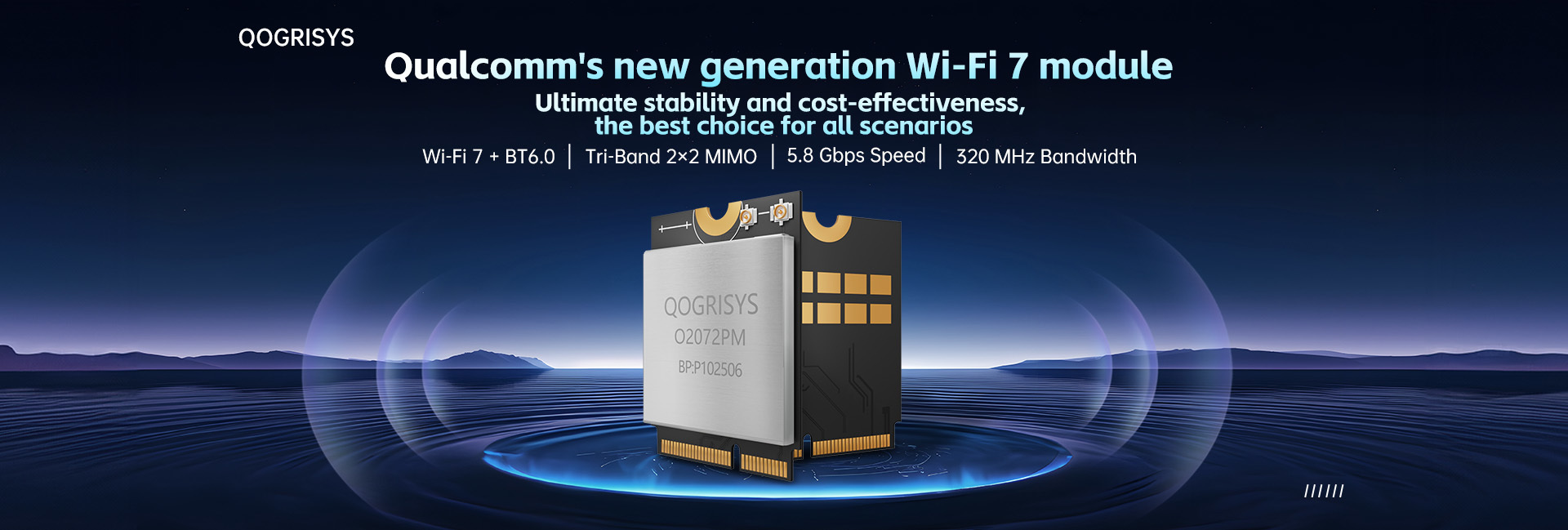
In October 2026, the TP-Link Archer 8 Ultra will be available for pre-order simultaneously in the UK, Germany, and Australia, priced at £669.99. This is the world's first complete Wi-Fi 8 series product aimed at the consumer market . However, what is truly noteworthy is not the router's theoretical aggregation speed of 19Gbps, but a more fundamental technological shift: Wi-Fi 8 (IEEE 802.11bn) is abandoning the traditional path of "each generation must be faster," and shifting its focus to reliability, coverage, and concurrency efficiency in real-world network environments . What does this shift mean for Wi-Fi module solution providers? If Wi-Fi 7 addressed the "peak speed ceiling" problem, Wi-Fi 8 aims to solve the "lower limit of actual user experience." The two technologies have different technical logics, and the corresponding module design approaches, chip selection criteria, and supply chain preparation schedules will also change accordingly. The "time difference" between the standard timeline and the commercial pace To understand the commercialization process of Wi-Fi 8, we first need to clarify a key fact: there is a significant time lag between product launch and standard finalization . According to the latest progress from the IEEE 802.11 working group, final approval of the Wi-Fi 8 standard is expected in May 2028 , while the Wi-Fi Alliance's certification program is scheduled to launch during CES in January 2028. Rolf de Vegt, Qualcomm's Vice President of Technical Standards, confirmed that Draft 2.0 will be finalized at the IEEE meeting in July 2026; this version is generally considered a sign that core technical features are stabilizing . This "product-first, standards-undefined" approach presents unique selection challenges for module solution providers: early chip solutions may have inconsistent feature completeness, and some Wi-Fi 8 functions require subsequent firmware updates to activate. TP-Link has explicitly stated that features such as DSO (Dynamic Subband Operation), ELR (Enhanced Long Distance Transmission), and DRU (Distributed Resource Unit) on the Archer 8 Ultra will be gradually released through OTA updates . A shift in technological logic: from "peak rate" to "consistent throughput" The technical goals of Wi-Fi 8 can be summarized by a set of figures: 25% increase in data rate, 25% reduction in tail latency, and 25% reduction in lost MAC protocol data units . The design intent of these goals is clear—not to make a single device run faster, but to make connections more stable across multiple devices, over long distances, and in environments with interference. The specific technical mechanisms include several levels: Multi-AP Coordination is the core architectural change in Wi-Fi 8. Unlike Wi-Fi 7 where each AP works independently, Wi-Fi 8 allows multiple routers to form a coordinated network, even serving a single device simultaneously . This means that in Mesh networking or enterprise deployments, interference between APs can be actively managed, rather than passively avoided. Enhanced Long Range Transmission (ELR) and Distributed Resource Units (DRUs) are designed for edge-of-signal scenarios. TP-Link's test data shows that over medium to large distances, Wi-Fi 8 offers a 33% improvement in throughput consistency compared to Wi-Fi 7 ; in interference environments, throughput consistency is improved by 24% . Receiver sensitivity is improved by 1-3 dB in the 5GHz and 6GHz bands . Non-Primary Channel Access (NPCA) and Dynamic Sub-Band Operation (DSO) address the issue of spectrum coexistence. NPCA allows APs to dynamically switch when the primary channel is congested, while DSO supports the efficient coexistence of devices with different bandwidth capabilities within the same network . MediaTek claims that its NPCA+ technology can improve throughput by approximately 80% in high-density environments with overlapping multi-networks . From a physical layer perspective, Wi-Fi 8 introduces a new 3888-bit LDPC code , an extension of the existing 648, 1296, and 1944-bit codes. This longer code block provides a coding gain of 0.5–1.0 dB at higher MCS levels and in multi-spatial-stream scenarios , at the cost of requiring parallel decoding capabilities, which may limit its performance in narrow-channel 2.4 GHz bands . An overlooked accelerating factor: storage cost pressures Behind the accelerated commercialization of Wi-Fi 8 lies a driving force unrelated to wireless technology itself: the continuous rise in memory chip prices . A Dell'Oro Group report in August 2026 indicated that the introduction of enterprise-grade Wi-Fi 8 could be brought forward to 2027 due to tight DDR4 memory supply and rising prices , allowing vendors to reduce their reliance on high-cost storage components through new architectural designs . The report's author, Siân Morgan, concluded: "The faster vendors change their AP designs to reduce their reliance on the highest-cost memory components, the more competitive they will be on price. This constitutes a strong incentive to move to Wi-Fi 8." This logic also applies to Wi-Fi modules. If the architectural optimizations of Wi-Fi 8 can reduce the reliance on large-capacity memory in module solutions, then in an environment of high storage costs, the overall BOM cost structure of Wi-Fi 8 modules may be more competitive than that of Wi-Fi 7. The driving force behind technological upgrades comes not only from performance requirements but also from cost pressures from the upstream supply chain. Complementary rather than substitutive technologies: Wi-Fi 7 addresses the question of "how fast can it be," while Wi-Fi 8 addresses the question of "how stable can it be." To understand the relationship between Wi-Fi 7 and Wi-Fi 8, we need to go back to the core design goals of IEEE 802.11bn. The technical logic behind Wi-Fi 7 (IEEE 802.11be, Extremely High Throughput) is to push peak speeds to the limit : 320MHz channels, 4096-QAM, Multi-Link Operation (MLO), Multi-Resource Unit (Multi-RU), and preamble puncturing . Research published in IEEE Communications Standards Magazine indicates that Wi-Fi 7 aims to achieve "throughputs up to 30 Gbps and lower latency than Wi-Fi 6." These characteristics correspond to high-bandwidth, low-latency scenarios such as 8K video streaming, VR/AR, and cloud gaming. The technical logic of Wi-Fi 8 (IEEE 802.11bn, Ultra High Reliability) has undergone a fundamental shift. According to the technical lecture summary of IEEE Region 6, Wi-Fi 8 "maintains peak rates" while shifting its focus to "reliability, lower latency, less packet loss, and stable throughput under load ." Its core technical means include multi-AP coordination, coordinated spatial multiplexing, non-primary channel access, and enhanced long-distance operation—all pointing to the same goal: to allow users to experience throughput closer to theoretical values in real-world network environments with dense interference, diverse devices, and proximity to the edge . This difference in positioning determines the complementarity of Wi-Fi 7 and Wi-Fi 8 in application scenarios. For scenarios requiring extreme speeds (VR wireless streaming, 8K live streaming, high-speed file transfer), Wi-Fi 7's 320MHz and MLO are core capabilities; for scenarios requiring extreme reliability (industrial automation, AGV/AMR, telemedicine, smart home whole-house coverage), Wi-Fi 8's Multi-AP coordination and ELR are key. The two are not in a "new generation replacing the old generation" relationship, but rather a coexistence relationship where each leverages its strengths in different scenarios. The practical significance of Qogrisys Wi-Fi 7 module solution During this window of time when generations coexist, the value of module solution providers lies not in "betting on which generation of technology will win," but in providing suitable Wi-Fi 7 module options for different scenarios, while reserving the ability to switch to Wi-Fi 8 technology . Taking the O2072PM module from Qogrisys as an example, this module is based on the Qualcomm QCC2072 (FastConnect C7700) design, supports 320MHz channels, 4096-QAM, MLO, tri-band 2.4/5/6GHz concurrent operation, peak data rate of 5.8 Gbps, and Bluetooth supports BLE 6.0 and LE Audio . These features directly correspond to the core capabilities of Wi-Fi 7, making it suitable for industrial gateways, smart terminals, and embedded systems that require high throughput and low latency. The market viability of these Wi-Fi 7 module solutions in the current and next two years is based on the following facts: First, the Wi-Fi 7 terminal ecosystem is already mature. Intel's Wi-Fi 7 product line has been continuously iterated from BE200 (Q3 2023) to BE213/BE211 (Q4 2025) , and the Wi-Fi 7 platform has been fully deployed in routers, mobile phones, and PCs. Module solution providers do not need to wait for "terminal readiness" because terminals are already being shipped. Secondly, the chip production capacity and supply chain for Wi-Fi 7 have stabilized. The capacity utilization rate of Wi-Fi 7 modules is projected to be only 62.3% in 2026, indicating a structural oversupply . This means that chip supply is no longer a bottleneck, and module manufacturers can obtain competitive procurement costs and stable delivery times. Third, early demand for Wi-Fi 8 modules will primarily appear in enterprise and industrial applications, rather than consumer applications. Dell'Oro Group predicts that enterprise-grade Wi-Fi 8 may be introduced as early as 2027, driven by storage cost pressures rather than end-user demand . Large-scale demand for consumer-grade Wi-Fi 8 modules will require waiting for the standard to be finalized in 2028 and for end devices to fully adopt it. Key conclusions First, the dominant position of Wi-Fi 7 modules in shipments from 2026 to 2028 will be determined by the terminal iteration cycle, rather than by technological superiority or inferiority. The expected annual shipment of 234 million units and a 46% contribution rate to sales revenue indicate that Wi-Fi 7 has entered a period of large-scale returns. Secondly, Wi-Fi 8's "reliability-first" positioning makes it complementary to Wi-Fi 7 in various scenarios, rather than a simple replacement. Wi-Fi 7 addresses "speed," while Wi-Fi 8 addresses "stability." The two will coexist in high-density, long-distance, and multi-device coexistence scenarios for a long time. Third, the core strategy of module solution providers at this stage is to cover mature terminal needs with Wi-Fi 7 solutions, while reserving a technical window for Wi-Fi 8 FEM pre-research and chip platform evaluation. Wi-Fi 8 RF front-end pre-research needs to be coordinated with the SoC ecosystem, and this preparation should be completed in 2026-2027.      

2026

10/12

Renovasi Hotel Cerdas: Komunikasi Jalur Daya PLC sebagai Tulang Punggung Konektivitas
I. Pasar eksisting senilai triliunan yuan sedang terbuka Industri perhotelan Tiongkok telah memasuki era stok. Selama tiga tahun ke depan, 732.000 kamar yang berusia lebih dari 15 tahun akan memasuki siklus renovasi yang terkonsentrasi , dengan ukuran pasar yang sudah melebihi 100 miliar yuan. Sejak 2026, jumlah kontrak renovasi yang ditandatangani telah melampaui total jumlah untuk seluruh tahun sebelumnya, dan "renovasi" serta "rebranding" menjadi tindakan pendamping dalam peningkatan stok hotel Tiongkok. Tantangan inti dari renovasi hotel yang ada terletak pada kebutuhan untuk meningkatkan kamar tamu dengan teknologi pintar sambil mempertahankan operasional dan meminimalkan gangguan kepada tamu. Hal ini menimbulkan tuntutan pada biaya konstruksi dan fleksibilitas penerapan teknologi komunikasi yang jauh melebihi proyek baru. II . Tren Pasar Pasar hotel pintar saat ini sedang mengalami periode ekspansi struktural. Perusahaan riset pasar memprediksi bahwa pasar hotel pintar global akan tumbuh menjadi US$90,46 miliar pada tahun 2032 , mewakili tingkat pertumbuhan tahunan gabungan sebesar 14,20%. Wilayah Asia-Pasifik adalah area dengan pertumbuhan tercepat, didorong oleh penetrasi smartphone yang tinggi, ekspansi pariwisata perkotaan, dan modernisasi hotel skala besar. Dalam hal teknologi konektivitas, PLC bertransformasi dari "pelengkap solusi nirkabel" menjadi "basis koneksi untuk kontrol kamar tamu hotel ." Penilaian ini tidak hanya didasarkan pada data implementasi Lihe Micro tetapi juga pada perubahan lanskap kompetitif: sistem kontrol kamar tamu hotel pintar INNCOM FLEX Honeywell, yang dirilis pada September 2026, secara eksplisit mendukung "solusi penerapan ganda kabel dan nirkabel" dan kompatibel dengan protokol bangunan utama seperti BACnet IP dan Modbus TCP, mencerminkan pengakuan produsen otomatisasi bangunan terkemuka terhadap pendekatan "kompatibilitas multi-protokol dan penerapan terbuka". III . Dilema Antara Kabel dan Nirkabel Sistem kontrol kamar tamu hotel tradisional menghadapi dilema struktural. Solusi kabel (bus RS-485, Ethernet TCP/IP) menawarkan komunikasi yang stabil dan andal dengan kemampuan anti-gangguan yang kuat dan tanpa masalah kehilangan paket data, tetapi memerlukan pemasangan kabel komunikasi khusus. Dalam skenario renovasi yang ada, ini berarti penggalian, pembongkaran langit-langit, dan perbaikan dinding, yang mengakibatkan periode konstruksi yang panjang dan seringkali memerlukan penutupan atau konstruksi bertahap, yang secara signifikan memengaruhi operasional hotel. Jenis solusi ini lebih cocok untuk konstruksi baru atau renovasi total hotel kelas atas. Solusi nirkabel (Bluetooth Mesh, Zigbee, Wi-Fi) menawarkan opsi penerapan yang fleksibel, hanya memerlukan pemasangan kabel daya, menjadikannya hemat biaya dan mudah dipasang di hotel yang dikonversi. Namun, sinyal nirkabel menghadapi tantangan dalam struktur hotel yang kompleks, seperti pelemahan dinding, halangan kabinet logam, dan gangguan ko-saluran, yang mengakibatkan stabilitas komunikasi yang lebih lemah dibandingkan metode kabel. Selain itu, lokasi peralatan sangat memengaruhi kualitas sinyal. Tidak ada satu pun pendekatan teknologi yang dapat secara bersamaan memenuhi persyaratan ganda "transformasi tanpa gangguan" dan "komunikasi yang sangat andal." Yang dibutuhkan industri adalah jalur ketiga. IV . PLC: Menyelesaikan konflik antara "jalur daya yang ada" dan "pengkabelan baru". Logika inti PLC (Power Line Carrier Communication) berbeda secara fundamental dari solusi tradisional. Solusi nirkabel mengandalkan propagasi gelombang elektromagnetik, dan sinyal mengalami pelemahan yang signifikan saat melewati dinding beton penahan beban dan struktur logam. Sebaliknya, PLC menggunakan jalur daya 220V/380V yang ada di gedung sebagai media transmisi data. Sinyal berjalan di sepanjang jalur daya dan tidak terpengaruh oleh hambatan fisik dari dinding, lantai, atau struktur logam—selama sirkuit diberi daya, tautan komunikasi tetap stabil . Data pengujian dunia nyata mendukung karakteristik teknis ini: latensi respons ujung ke ujung PLC-IoT secara konsisten di bawah 50 milidetik , dan tingkat keberhasilan komunikasi secara nominal setinggi 99,99% ; satu host dapat mendukung 128–384 node perangkat; penelitian akademis mengkonfirmasi bahwa PLC-IoT memiliki keunggulan komprehensif dibandingkan teknologi ZigBee dan KNX dalam hal stabilitas, efektivitas biaya, dan kemampuan anti-gangguan. Untuk proyek renovasi hotel, fitur paling berharga dari PLC adalah menghilangkan kebutuhan akan pengkabelan. V. Ekosistem terbuka menggantikan solusi tertutup Adopsi teknologi PLC yang dipercepat di industri perhotelan juga mendapat manfaat dari refleksi industri terhadap "solusi kontrol kamar tamu loop tertutup". Saat ini, sebagian besar proyek kontrol kamar tamu pintar hotel mengadopsi solusi loop tertutup, dengan sistem, peralatan, dan platform hotel sangat bergantung pada satu pemasok. Jika vendor mengalami masalah operasional atau teknis, seluruh sistem kontrol kamar tamu dapat lumpuh. Selain itu, protokol komunikasi yang tidak kompatibel antara perangkat gateway dari merek yang berbeda mencegah interoperabilitas dan menghambat ekspansi sistem, yang mengakibatkan biaya yang terus-menerus tinggi untuk peningkatan, pemeliharaan, dan iterasi hotel di kemudian hari. Berdasarkan standar protokol terpadu, ekosistem PLCP menyatukan produk-produk seperti panel sakelar, driver lampu, motor tirai, dan panel kontrol suhu dari banyak produsen peralatan. Hotel dapat secara fleksibel memilih dari berbagai merek dan kategori, menghilangkan risiko rantai pasokan dari "satu vendor memonopoli" produk. Tren ini menawarkan pesan yang jelas untuk produsen modul: pelanggan hotel tidak lagi hanya membeli "gateway + satu set peralatan," tetapi mencari "standar + ekosistem." Sebagai lapisan komunikasi dasar, modul perlu kompatibel dengan tumpukan protokol utama. VI . Slot modul PLC dari Qogrisys Shenzhen Ofeixin Technology Co., Ltd. telah mengembangkan dua produk modul inti untuk skenario hotel di bidang PLC. 3121N-H (berbasis HiSilicon Hi3121S) didasarkan pada subset standar IEEE 1901.1. Satu CCO mendukung hingga 200 node STA , perutean dinamis, dan pengalamatan multi-jalur otomatis. Jaringan dua tingkat dengan 200 node yang khas dapat diatur dalam waktu 10 detik . Ukuran modul adalah 23,5×30mm, mengintegrasikan driver jalur bawaan dan sirkuit kopling onboard, dan menyediakan antarmuka seperti UART, PWM, GPIO, I2C, dan ADC. Qogrisys juga telah merancang kit PLC + catu daya terintegrasi dengan transformator konversi bawaan untuk koneksi langsung ke daya AC dua arah 220V, memfasilitasi adopsi produk yang cepat oleh penyedia solusi kontrol pelanggan. S130N-ISI (berbasis Leadcore VC6330) menggunakan paket LCC, berukuran hanya 20,6×12,6mm , menjadikan desainnya yang sangat kecil cocok untuk perangkat panel hotel yang terbatas ruang. Ini mengintegrasikan MCU ARM Cortex-M3 32-bit dan prosesor dual-core DSP 32-bit, mendukung protokol China SGCC Q/GDW 11612 dan IEEE 1901.1 . Chip Leadcore VC6330 mencapai tingkat komunikasi lapisan aplikasi hingga 1Mbps, dengan tingkat keberhasilan komunikasi 99,99% dalam proyek aktual dan latensi komunikasi jaringan Tingkat 1

2026

09/22